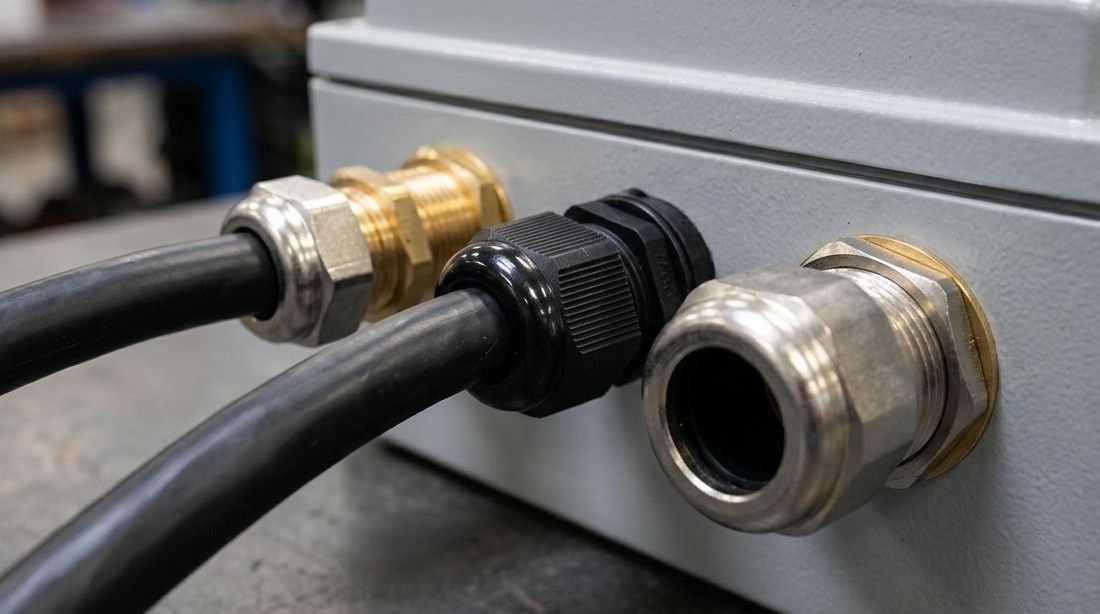
A cable gland may be small, but it carries a big responsibility. It seals every cable entry point, holds the cable firmly and keeps dust and moisture away from live connections. Fitted correctly, it works quietly for years. Fitted carelessly, it quickly becomes the weakest point in the system.
Most failures trace back to simple installation mistakes rather than poor products. Here are the five that cause the most damage on site, and how to avoid them.
Why These Mistakes Matter More Than People Think
An enclosure is only as protected as its weakest gland. Even a premium IP68 rated panel can behave like a basic IP54 unit if the gland fitted to it was installed carelessly. Once water or dust finds a way in through a poorly sealed gland, it can spread inside the enclosure, damage nearby components and shorten the life of the whole system.
For engineers and contractors working on industrial, commercial or outdoor projects, understanding these mistakes directly affects safety, compliance and how much money gets spent on repairs later.
Mistake One Choosing the Wrong Gland Size
Size is where most installation problems begin. A gland that is too small will not close around the cable properly, leaving small gaps that let in moisture over time. A gland that is too large will not grip the cable at all, so there is no strain relief and the cable can slip out under vibration.
The fix is simple. Always measure the actual outer diameter of the cable rather than assuming it matches the nominal size printed on the jacket, and compare that measurement against the manufacturer’s clamping range before fitting anything.
| Cable Fit | What Happens | Result |
| Gland too small | Cable cannot pass through cleanly | Damaged insulation and stressed conductors |
| Gland too large | No proper grip on cable jacket | Water ingress and cable slippage |
| Correctly sized | Snug seal around cable | Full IP protection and secure hold |
Mistake Two Using the Wrong Type of Gland for the Cable
Not every gland works for every cable. A single compression gland suits unarmoured cables in indoor or low risk areas. A double compression gland is built for armoured cables and gives the armour a proper mechanical grip and earth path. Using one in place of the other is a common shortcut that causes trouble later, especially with armoured cables where poor earthing becomes a safety hazard rather than just a sealing issue.
Before buying anything, check whether the cable is armoured or unarmoured, whether the site needs a flameproof gland for a hazardous zone, and whether it will face outdoor exposure. Our earlier guide on cable gland types sizes and installation breaks down each gland type if you want to match the right product to your cable before ordering.
Mistake Three Ignoring the IP Rating for the Environment
The IP rating tells you exactly how much protection a gland offers against dust and water, and it should always match where the gland will be installed. An IP54 gland suits a dry indoor panel but will not hold up outdoors. An IP68 gland is built for continuous immersion and suits marine, underground or wash down environments.
The mistake many installers make is picking a gland based on price rather than environment, or assuming a higher rated enclosure automatically protects a lower rated gland fitted inside it. Every entry point needs its own correctly rated gland to keep the whole system sealed.
| IP Rating | Typical Environment | Protection Level |
| IP54 | Dry indoor panels | Limited dust and splash resistance |
| IP65 | Outdoor cabinets and light rain areas | Dust tight and low pressure jets |
| IP67 | Areas with occasional flooding | Temporary immersion up to one metre |
| IP68 | Marine, underground and wash down zones | Continuous immersion protection |
If you are sourcing glands for a project with mixed environments, working with an established cable gland supplier UAE makes it easier to get the correct rating for every entry point in one order.
Mistake Four Over Tightening or Under Tightening
Torque is often overlooked, yet it decides whether a gland performs the way it was designed to. Over tightening can crack the gland body, deform the cable sheath or damage the insulation. Under tightening leaves small gaps around the seal, which quickly become entry points for dust and water once the equipment starts vibrating during normal operation.
Most manufacturers publish an exact torque value in their datasheet, and using a torque wrench instead of tightening by feel removes the guesswork. It takes a few extra minutes per gland but protects the seal for the life of the installation.
Mistake Five Skipping Cable Preparation and Earthing
Uneven stripping, damaged insulation or sharp edges left on the armour undermine the seal no matter how good the gland is. For armoured cables, the armour must be trimmed cleanly and clamped securely to keep a continuous earth path to the panel. This is a quiet failure that shows up months later through corrosion or vibration damage.
Knowing the cable you are working with helps too. Our guide on power cable vs control cable explains how construction differs between the two and how that affects preparation.
A properly earthed gland only matters if the panel behind it is protected correctly. Our guide on the difference between MCB and MCCB is a useful next step for the rest of the enclosure.
A Quick Checklist Before You Fit the Next Gland
- Measure the cable outer diameter against the gland clamping range
- Match the gland type to armoured or unarmoured cable construction
- Confirm the IP rating suits the installation environment
- Use a torque wrench and follow the manufacturer’s specification
- Prepare the cable end cleanly and check earth continuity
Following this order removes most of the common mistakes and keeps your installation compliant.
Conclusion
Cable glands may be small, but the role they play in protecting an electrical system is significant. Avoiding these five mistakes, from wrong sizing and mismatched gland types to poor torque control and rushed cable preparation, keeps your installation sealed, safe and built to last. Getting it right the first time saves both money and downtime later.
Ready to Get the Right Cable Glands for Your Project
Sourcing glands from a trusted supplier ensures every unit meets its stated IP rating and comes with proper technical support for any sizing question on site.
Whether you need a single gland for a small panel or a complete set for a large industrial project, Aswan Electric provides genuine products, expert guidance and dependable support across all project requirements.
Contact our team today to discuss the right cable gland solution for your application.
Explore More Electrical Guides and Articles
- MCB vs MCCB Complete Comparison Guide breaks down current rating, breaking capacity and application differences so you can decide which breaker actually fits your circuit.
- Choosing Between Schneider and Siemens for Your Project compares two of the leading MCCB and switchgear brands to help you pick the right platform for your panel.
- ABB vs Siemens Complete Industrial Solutions Guide looks at automation and protection equipment from both manufacturers, useful context when sourcing MCCBs for industrial panels.
- Everything You Need to Know About Limit Switches covers another core protection and control device often specified alongside MCCBs in industrial panels.
- 10 Common Industrial Problems Solved by Limit Switches shows how proper device selection prevents downtime, a principle that applies just as much to MCCBs as it does to limit switches.