Electrical protection devices play a critical role in maintaining the safety, reliability, and performance of modern electrical systems. Whether it is a residential apartment, commercial building, industrial plant, or infrastructure project, selecting the right circuit protection device is essential for preventing overloads, short circuits, equipment damage, and electrical hazards.
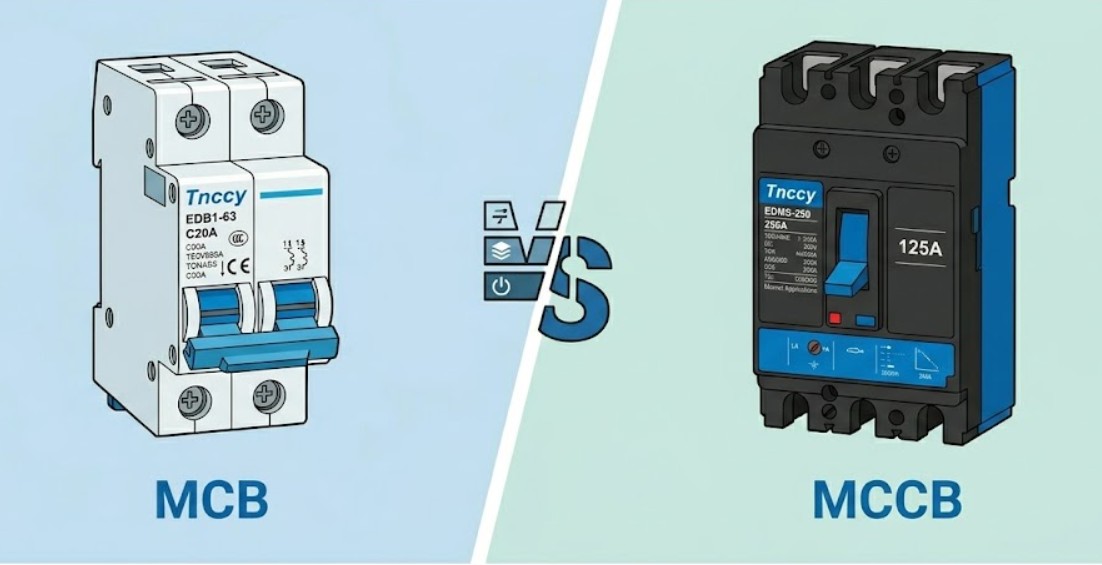
Among the most widely used protection devices are the Miniature Circuit Breaker (MCB) and the Molded Case Circuit Breaker (MCCB). Although both devices are designed to interrupt electrical faults and protect circuits, they differ significantly in current capacity, breaking capacity, application areas, adjustability, and system complexity.
What Is an MCB?
An MCB or Miniature Circuit Breaker is a low-voltage protective device designed to automatically disconnect an electrical circuit when an overload or short circuit occurs. It is mainly used in systems where electrical demand is relatively low and protection requirements are simple.
MCBs are commonly installed in residential buildings, apartments, villas, small offices, retail shops, lighting circuits, and distribution boards. Their compact size makes them ideal for installations where space is limited.
MCBs operate quickly during fault conditions and can be manually reset after tripping, making them a convenient and cost-effective protection solution for everyday electrical systems.
Key Features of MCB
MCBs are designed to offer simple and reliable protection. They are compact in design, respond quickly to faults, and come with fixed trip settings that do not require adjustment. They are widely used in 1P, 2P, 3P, and 4P configurations depending on system requirements.
What Is an MCCB?
An MCCB or Molded Case Circuit Breaker is an advanced protection device designed for higher electrical loads and more complex systems. It is widely used in industrial and commercial environments where electrical demand is significantly higher.
Unlike MCBs, MCCBs offer adjustable protection settings and higher breaking capacity, making them suitable for critical and high-power applications.
MCCBs are commonly used in industrial plants, commercial buildings, motor control systems, data centers, HVAC systems, and large-scale power distribution networks where reliability and flexibility are essential.
Key Features of MCCB
MCCBs are designed for heavy-duty electrical systems. They support higher current ratings, adjustable trip settings for overload and short circuit protection, and improved fault interruption capacity. They also allow better coordination in complex electrical networks and can be integrated into automated control systems.
Difference Between MCB and MCCB
1. Full Form
MCB stands for Miniature Circuit Breaker, while MCCB stands for Molded Case Circuit Breaker. Both devices serve the purpose of circuit protection but differ in scale and application.
2. Current Rating
MCBs are designed for low current applications, typically up to 125A, making them suitable for residential and light commercial use.
MCCBs handle much higher current levels, ranging from 10A up to 2500A, making them suitable for industrial and large commercial installations.
3. Interrupting Capacity
MCBs have a breaking capacity typically between 6kA to 18kA, suitable for standard residential systems.
MCCBs offer significantly higher breaking capacity, usually between 10kA to 200kA, allowing them to handle severe fault conditions in industrial environments.
4. Trip Characteristics
MCBs come with fixed trip settings and limited flexibility, making them suitable for standard protection needs.
MCCBs offer adjustable trip settings, allowing customization for overload, short circuit, and in some cases ground fault protection.
5. Application Areas
MCBs are commonly used in residential wiring systems, lighting circuits, small offices, and light commercial setups.
MCCBs are used in industrial systems, heavy machinery, motor control centers, HVAC systems, and large commercial buildings.
6. Physical Siz
MCBs are compact and designed for DIN rail mounting, making them ideal for small distribution boards.
MCCBs are larger and more robust due to their higher capacity and industrial-grade construction.
7. Voltage Rating
MCBs are typically used in systems up to 415V.
MCCBs can handle higher voltage levels, often exceeding 600V, making them suitable for industrial applications.
8. Remote Operatio
MCBs generally support manual operation only.
MCCBs can support remote operation and integration into automated electrical systems.
9. Cost Difference
MCBs are more economical due to their simple design and lower capacity.
MCCBs are more expensive due to advanced features, higher capacity, and industrial-grade construction.
MCB vs MCCB Comparison Table
| Feature | MCB | MCCB |
| Full Form | Miniature Circuit Breaker | Molded Case Circuit Breaker |
| Current Rating | Up to 125A | Up to 2500A |
| Interrupting Capacity | Lower | Higher |
| Trip Settings | Fixed | Adjustable |
| Application | Residential | Industrial & Commercial |
| Size | Compact | Larger |
| Cost | Lower | Higher |
| Remote Operation | No | Yes |
| Voltage Handling | Lower | Higher |
Which Is Better: MCB or MCCB?
There is no universal “better” option between MCB and MCCB. The selection depends entirely on system requirements, load demand, and application type.
MCBs are ideal for residential environments, small offices, and low-load electrical systems where simplicity and cost-effectiveness are important.
MCCBs are more suitable for industrial and commercial applications where high load capacity, adjustable protection, and system coordination are required.
Importance of Choosing the Right Electrical Protection Device
Selecting the correct circuit breaker is essential for maintaining electrical safety and system efficiency. Incorrect selection can lead to frequent tripping, overheating, equipment damage, or system failure.
Proper selection ensures stable performance, improved safety, and long-term reliability of electrical systems.
How to Select the Right Circuit Breaker
Selecting the right circuit breaker involves evaluating load requirements, fault levels, system expansion plans, installation space, and protection coordination needs. Compliance with international electrical standards is also essential to ensure safety and system reliability.
Proper evaluation ensures long-term performance and reduces operational risks.
Conclusion
MCBs and MCCBs both play an important role in electrical protection systems, but they are designed for different applications. MCBs are suitable for residential and low-load systems, while MCCBs are built for industrial and high-capacity electrical environments.
Choosing the right device ensures safety, stability, and long-term system reliability.
For more technical insights, electrical solutions, and product information, you can explore Aswan Electric, a reliable source for electrical products and industry resources.
For inquiries, technical support, or project assistance, you can also visit the Contact Page where our team provides professional guidance for product selection and system requirements.
Explore More Electrical Guides & Articles
- Power Cable vs Control Cable: Which Is Better? – Understand the key differences between power and control cables and their specific applications in electrical systems.
- Cable Glands Explained: Types, Sizes and Installation Guide – Learn about different cable gland types, sizing standards, and proper installation methods for safe cable management.
- Why Smart Businesses Work with Schneider Electric Suppliers – Discover the benefits of partnering with authorized Schneider Electric suppliers for reliable and efficient electrical solutions.
- What Are Rubber Cables? Types, Benefits & Applications – Explore rubber cable types, their durability, and where they are commonly used in industrial and heavy-duty environments.
- The Ultimate Introductory Guide to Electrical Wires & Cables – Get a complete overview of electrical wires and cables, their classifications, and fundamental usage in modern electrical systems.