Every electrical installation, whether a home, office, or factory, depends on one critical device working correctly behind the scenes: the Miniature Circuit Breaker. It sits quietly in your distribution board until something goes wrong, and then it has to act fast and correctly. Choose the wrong one, and it either trips unnecessarily or fails to protect when it matters most.
This guide walks through everything you need to know to make the right selection, from understanding how an MCB works to matching trip curves, current ratings, and breaking capacities to your specific application.
What Is a Miniature Circuit Breaker and How Does It Work?
A Miniature Circuit Breaker (MCB) is an automatic switching device that protects electrical circuits from two major threats: overloads and short circuits.
Under normal conditions, current flows through the MCB without interruption. When the current exceeds the rated threshold, a bimetallic strip inside the breaker heats up, bends, and releases a latch, breaking the circuit. This is called the thermal tripping mechanism and it handles slow-building overloads.
In the case of a short circuit, the current surge is sudden and extreme. A magnetic solenoid detects this and trips the breaker almost instantaneously, within milliseconds. Once the fault is cleared, the MCB can simply be reset, unlike a fuse that must be replaced.
This combination of thermal and magnetic protection makes MCBs the standard choice in modern electrical systems worldwide.
Understanding MCB Poles: Single, Double, and Three-Pole
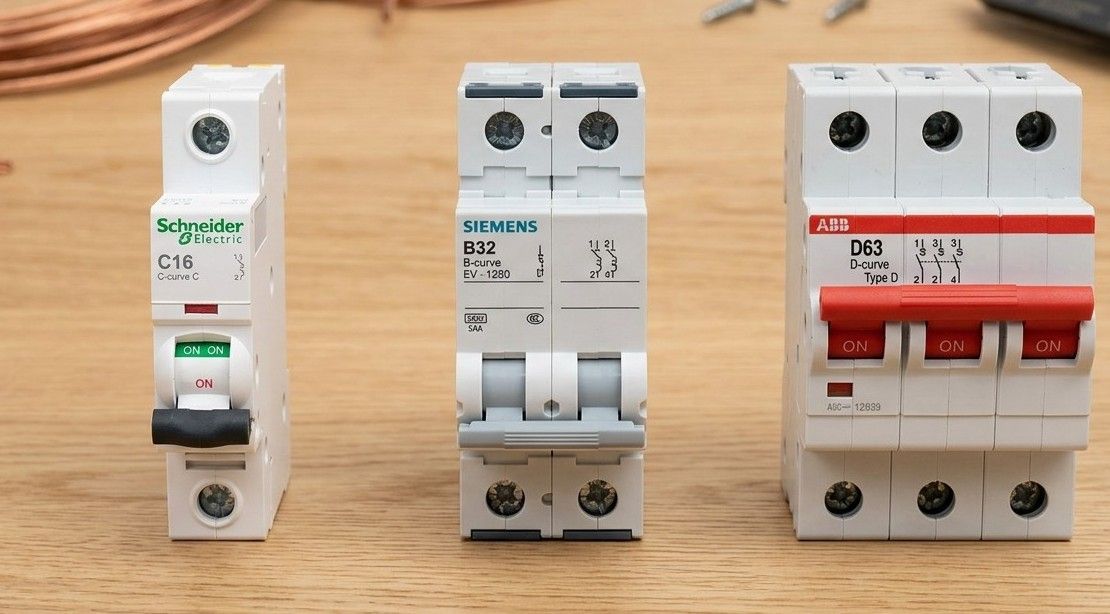
Before selecting an MCB, you need to determine how many poles your circuit requires. The number of poles corresponds directly to the number of live conductors being protected.
A single-pole MCB handles one live wire and is rated for 120-230V. It is the most common choice for lighting circuits and standard socket outlets in residential settings.
A double-pole MCB protects two live conductors simultaneously and is used for higher-power appliances drawing up to 240V. Both poles trip together when a fault is detected.
A three-pole MCB is designed for three-phase systems found in commercial and industrial environments. It can handle voltages up to 415-500V and is essential for protecting motors, heavy machinery, and large distribution boards.
Matching the number of poles to your installation type is non-negotiable. A single-pole breaker on a three-phase motor circuit offers incomplete protection and creates a safety hazard.
Trip Curve Types Explained: B, C, and D
This is where most purchasing mistakes happen. The trip curve determines how quickly an MCB responds to overcurrent, and different loads behave very differently at startup versus during normal operation.
Type B MCB
Type B breakers trip when the current reaches 3 to 5 times the rated value. They respond quickly to even moderate overcurrents, making them ideal for resistive loads that do not produce high inrush currents.
Best for: Residential lighting, socket circuits, basic home appliances, and general domestic wiring.
If you are wiring a home or a small apartment building, Type B MCBs are the standard choice. They are sensitive enough to catch faults early without being so responsive that they trip during normal use.
Type C MCB
Type C breakers trip at 5 to 10 times the rated current. This slightly higher threshold accommodates the brief inrush current that inductive loads draw when they first start up.
Best for: Commercial spaces, offices, fluorescent lighting systems, small motors, HVAC units, and transformers.
A circuit breaker supplier with a broad product range will typically stock Type C as their most versatile commercial option, and for good reason. It handles the widest variety of mixed-load environments without nuisance tripping.
Type D MCB
Type D breakers trip at 10 to 20 times the rated current. They are built to withstand very high inrush currents during equipment startup and are not suitable for residential use due to their reduced sensitivity.
Best for: Industrial environments, large motors, X-ray machines, welding equipment, and any machinery with exceptionally high starting current.
Choosing the wrong curve type in either direction creates problems. Too sensitive (Type B on a motor circuit) leads to constant nuisance trips. Not sensitive enough (Type D on a home circuit) means the breaker may not respond in time to protect people and equipment.
Breaking Capacity (Icn): Why It Matters More Than People Think
Breaking capacity, denoted as Icn, is the maximum fault current an MCB can safely interrupt without being damaged or failing. It is expressed in kiloamperes (kA).
If the fault current in your system exceeds the MCB’s Icn rating, the breaker may not be able to stop the fault, potentially resulting in arcing, fire, or permanent damage to the device and the circuit.
Common Icn ratings available in the market include 4.5 kA, 6 kA, and 10 kA. For most residential installations, 6 kA is sufficient. Commercial and industrial sites with larger transformers and heavier loads often require 10 kA or higher.
To determine the right rating, consult the short-circuit current available at the point of installation. Your electrical engineer or the utility provider can supply this figure. The MCB’s Icn must equal or exceed this value.
Key MCB Parameters You Must Check Before Buying
When evaluating any MCB for purchase, these are the technical parameters to verify:
Rated Voltage: Ensure the MCB’s voltage rating matches or exceeds the system voltage. Residential circuits typically run at 230V; three-phase systems operate at 415V.
Rated Current (In): This is the continuous current the MCB can carry without tripping. It should be equal to or slightly higher than the expected load current on the circuit.
Trip Curve Type: As discussed above, B, C, or D depending on the load type.
Breaking Capacity (Icn): Must exceed the maximum fault current at the installation point.
Number of Poles: Must match the number of phases in the circuit.
Ambient Temperature Rating: MCBs are typically rated at 30-40 degrees C. In hotter environments like industrial plants or outdoor panels in UAE summers, a derating factor may need to be applied.
How to Select the Right MCB Current Rating
Getting the current rating right requires a straightforward calculation. Start by determining the total wattage of all devices connected to the circuit. Then divide by the system voltage to get the amperage.
Formula: Current (A) = Total Watts divided by Voltage (V)
For example, a circuit supplying 2,300 watts at 230V draws 10 amperes. You would select a 10A or 16A MCB, not a 6A (too low) or a 32A (too high, as it will not trip quickly enough to protect the wiring).
Working with a trusted miniature circuit breaker supplier gives you access to the full range of current ratings, from 6A for small lighting circuits up to 63A or 100A for larger sub-main feeds, ensuring you select the exact rating your circuit requires.
Also apply the 80% rule: the continuous load on the circuit should not exceed 80% of the MCB’s rated current. So a 16A MCB should not carry more than 12.8A continuously. This provides a safe buffer and prevents thermal degradation over time.
Application-Specific Selection Guide
Residential Homes: Use Type B MCBs at 6A to 32A for lighting and power circuits. Single-pole for standard circuits, double-pole for cookers, air conditioners, and water heaters. Icn of 6 kA is adequate for most homes.
Commercial Offices and Retail: Type C MCBs work best here due to the mix of computers, printers, HVAC systems, and lighting. Double-pole configurations for larger loads. Breaking capacity of 6-10 kA recommended.
Industrial Facilities: Type D MCBs are essential for motor protection circuits. Three-phase configurations with high Icn ratings (10 kA and above) handle the demands of manufacturing equipment, compressors, and CNC machines.
Motor Protection Specifically: The long-delay current setting should equal the motor’s rated full-load current. The instantaneous trip threshold should not exceed 8 to 15 times that rated current to account for startup inrush without causing mechanical stress.
Common Mistakes to Avoid
Oversizing the MCB: Many people assume a higher-rated MCB means better protection. It does not. An oversized MCB will not trip when it should, leaving wiring and devices unprotected.
Ignoring the trip curve: Selecting a Type B breaker for a circuit with motors or inductive loads will result in constant nuisance tripping. The breaker is doing exactly what it is designed to do, it is simply the wrong tool for the job.
Underrating the breaking capacity: Installing a 4.5 kA breaker in a commercial building where fault currents can reach 6-10 kA is a serious safety risk. Always verify the prospective short-circuit current (PSCC) at the installation point.
Skipping compliance checks: MCBs should meet recognized standards such as IEC 60898-1, CE marking, and regional electrical codes. Non-compliant products may appear functional but fail under fault conditions.
Conclusion
Choosing the right Miniature Circuit Breaker is not a guesswork decision. It is a technical one with direct consequences for safety, equipment longevity, and system reliability. Match the trip curve to the load type, verify the current rating against actual demand, confirm the breaking capacity against available fault currents, and always select the correct number of poles for your installation.
Taking shortcuts here puts people, property, and equipment at risk. Getting it right means a system that runs reliably for decades.
For genuine MCBs and a full range of distribution board products, visit Aswan Electric to explore trusted brands and professionally sourced electrical equipment.
For product inquiries, technical specifications, and customized electrical solutions, Contact Us for professional support with your next installation project.
Explore More Electrical Guides & Articles
- Power Cable vs Control Cable: Which Is Better? – Understand the key differences between power and control cables and their specific applications in electrical systems.
- Cable Glands Explained: Types, Sizes and Installation Guide – Learn about different cable gland types, sizing standards, and proper installation methods for safe cable management.
- Why Smart Businesses Work with Schneider Electric Suppliers – Discover the benefits of partnering with authorized Schneider Electric suppliers for reliable and efficient electrical solutions.
- What Are Rubber Cables? Types, Benefits & Applications – Explore rubber cable types, their durability, and where they are commonly used in industrial and heavy-duty environments.
- The Ultimate Introductory Guide to Electrical Wires & Cables – Get a complete overview of electrical wires and cables, their classifications, and fundamental usage in modern electrical systems.