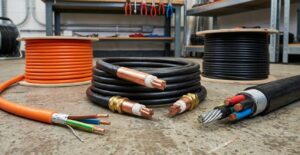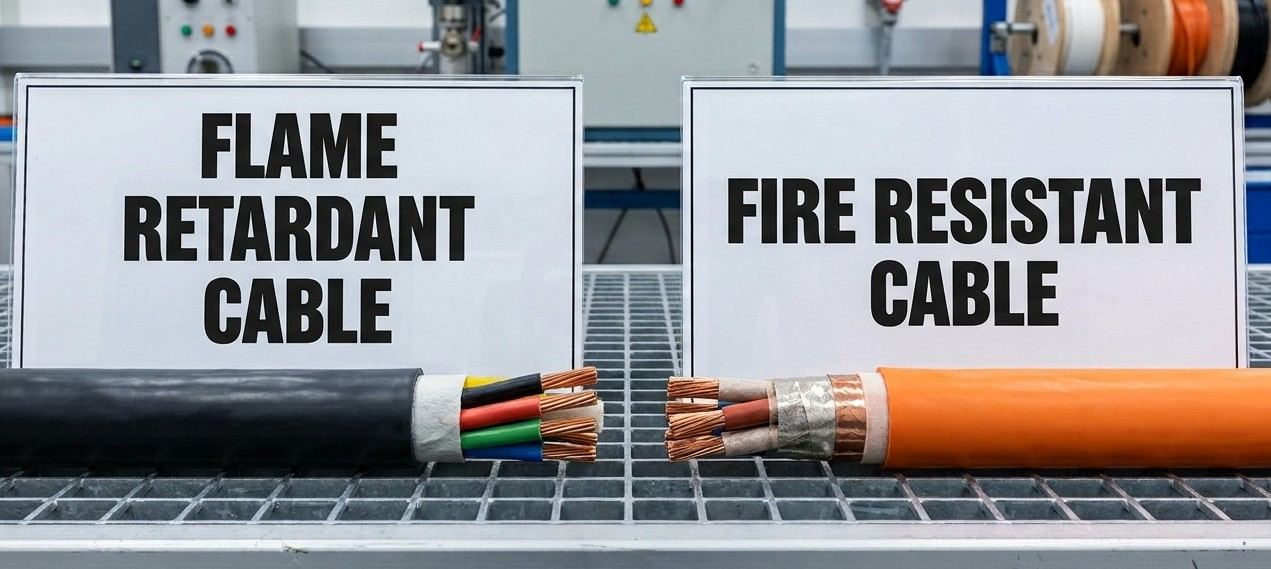
Fire resistant cable keeps powering emergency circuits while a fire burns. Flame retardant cable does not keep working, but it slows fire spread along the cable route. The main fire resistant types are mineral insulated cable, mica-taped polymer cable, and armoured fire rated cable. The main flame retardant types are flame retardant PVC, LSF, and LSZH. Match the rating to the circuit: IEC 60331 or BS 6387 for survival time, IEC 60332 for flame spread, and IEC 61034 for smoke.
Specifiers often treat fire resistant vs flame retardant cables as interchangeable terms. They are not. Each solves a different problem, and confusing them can leave life-safety systems dead when they are needed most.
What Is the Difference Between Fire Resistant and Flame Retardant Cables?
Fire-resistant cables are specialized electrical wires engineered to maintain circuit integrity and continue operating during a fire for a defined period, typically 30, 60, or 120 minutes. Flame retardant cables are designed to resist the spread of fire into a new area.
A flame retardant cable will eventually fail in a sustained fire. A fire rated cable carries a certified time rating that tells you how long the circuit stays alive.
How Do Fire Resistance Wires & Cables Work?
Fire Resistance Wires & Cables use materials that maintain electrical insulation under direct flame. Most designs wrap the conductor in a mica tape barrier, then add insulation such as cross-linked polyethylene and a low-smoke outer sheath. The mica layer forms a ceramic-like barrier as temperatures rise.
The conductor stays isolated even after the outer layers burn away.
Typical applications include:
- Emergency lighting and exit signage
- Fire alarm and voice evacuation circuits
- Smoke extraction fans and fire pumps
What Are the Main Fire Resistant Cable Types?
Fire resistant cable types fall into three broad groups: mineral insulated cables, mica-taped polymer cables, and enhanced fire performance armoured cables. Each maintains circuit integrity, but they differ in flexibility, cost, and temperature tolerance.
Mineral insulated cables use a copper sheath and magnesium oxide insulation. They survive extreme heat but are rigid and harder to terminate.
Mica-taped polymer cables are the common choice for commercial buildings. They offer easier installation and good flexibility, which suits most emergency lighting and alarm routes.
Armoured fire rated cable adds mechanical protection for impact-prone or buried routes.
How Do Flame Retardant Cables Work?
Flame retardance is the ability of a cable to resist ignition and self-extinguish once the external flame is removed. Manufacturers add halogenated or halogen-free fillers to the insulation and sheath. These additives interrupt combustion and limit how far fire travels along bundled cables.
In a dense cable tray, ordinary PVC can act like a fuse, carrying fire between floors. Flame retardant sheathing breaks that path.
What Are the Main Flame Retardant Cable Types?
Flame retardant cable types include flame retardant PVC, low smoke fume (LSF), and low smoke zero halogen (LSZH) cables. Each limits flame spread, but they differ sharply in smoke density and toxic gas output.
Flame retardant PVC is economical and suits general wiring in open areas. It releases dense smoke and halogen acid gas when burning.
LSF cables reduce smoke and some gas emissions. LSZH cables go further, emitting minimal smoke and no halogen acid gases. They are the preferred choice in tunnels, data centers, hospitals, and other enclosed spaces where visibility and air quality protect occupants and equipment.
Which Standards Define Each Cable Type?
Standards separate marketing claims from tested performance. Fire resistant cables are tested for circuit integrity under flame, while flame retardant cables are tested for flame propagation, smoke density, and gas emission. Always request test certificates rather than relying on datasheet wording.
Key references include:
- IEC 60331 for circuit integrity under fire conditions
- BS 6387 for fire, water, and mechanical shock resistance
- IEC 60332 for flame propagation on single and bundled cables
- IEC 61034 for smoke density
Where Should You Use Each Cable Type?
Use fire resistant cables for circuits that must operate during a fire, and flame retardant cables for general wiring where preventing fire spread is the priority. Many buildings need both, installed on different circuits according to function and risk.
A simple rule helps: if losing the circuit endangers evacuation or firefighting, specify fire resistance. If the concern is fire travelling along the cable route, specify flame retardance.
What Mistakes Do Engineers Make When Specifying Fire Cables?
The most common mistake is assuming a flame retardant cable offers circuit integrity. It does not. A cable that passes a flame propagation test may fail within minutes under direct fire, taking the emergency circuit with it.
Other frequent errors include:
- Ignoring the support system. Fire resistant cable fixed with plastic clips or ties loses its rating once the fixings melt.
- Mixing certified and uncertified accessories, such as glands and joints, which breaks the system rating.
- Skipping duration requirements. A 30-minute cable will not satisfy a 120-minute design.
Treat the cable, supports, and terminations as one tested system. A weak component voids the whole assembly.
Choosing the Right Cable for Your Facility
Fire resistant and flame retardant cables serve complementary roles. One preserves function, the other limits spread. Start with a circuit-by-circuit risk review, confirm the required standards and duration, and verify that supports and terminations match the cable rating.
Specify the Right Fire Cable for Every Circuit
Not sure which circuits need fire resistant cable and which need flame retardant? Aswan Electric, a supplier in UAE, can help you match fire rated cable and LSZH flame retardant cable to your circuit duration, exposure conditions, and smoke requirements, with certified test documentation.
Request a Cable QuoteFAQ
Are fire resistant cables also flame retardant?
Many are, but not automatically. Fire resistant cables are tested for circuit integrity, while flame retardance is a separate property. Check that the cable carries certificates for both if your design needs both.
Can I use flame retardant cables for emergency lighting?
No, not unless they are also certified as fire resistant. Emergency lighting must stay powered during evacuation, and flame retardant cables alone offer no guaranteed circuit integrity.
What does LSZH mean in cable specifications?
LSZH stands for low smoke zero halogen. These cables emit minimal smoke and no halogen acid gases when burning, which improves visibility and reduces toxic exposure in enclosed spaces.
Related Reading from Aswan Electric
Explore more guides on cables, drives, and electrical components for your next project.
- Fire Resistant Cable Types, Ratings, and Selection Guide
Compare cable types and ratings to match the right fire performance to each circuit. - VFD vs VSD: Key Differences
Understand how the two drive types differ before you specify motor control. - How to Choose the Right Variable Frequency Drive
Match drive size, load, and application requirements with confidence. - Fuse Holders Selection Guide: Types, Features, and Applications
Find the right fuse holder for your circuit protection needs. - Top 7 Applications of Rubber Flexible Cable in Construction
See where flexible rubber cable performs best on demanding job sites.