A VSD is any device that varies a machine’s speed (electronic, mechanical, hydraulic, or DC). A VFD is one specific type of VSD that controls an AC motor by changing the frequency and voltage it receives. Every VFD is a VSD, but not every VSD is a VFD.
Engineers and plant managers often use the terms VFD and VSD interchangeably, and that habit causes specification errors. The VFD vs VSD distinction matters when you size equipment, forecast energy savings, or protect motors.
Variable Speed Drives cover several technologies, and the wrong choice leads to mismatched hardware, wasted budget, and unplanned downtime. This guide clarifies the terminology, compares the options, and gives you a framework for selecting the right drive.
What Is the Difference Between a VFD and a VSD?
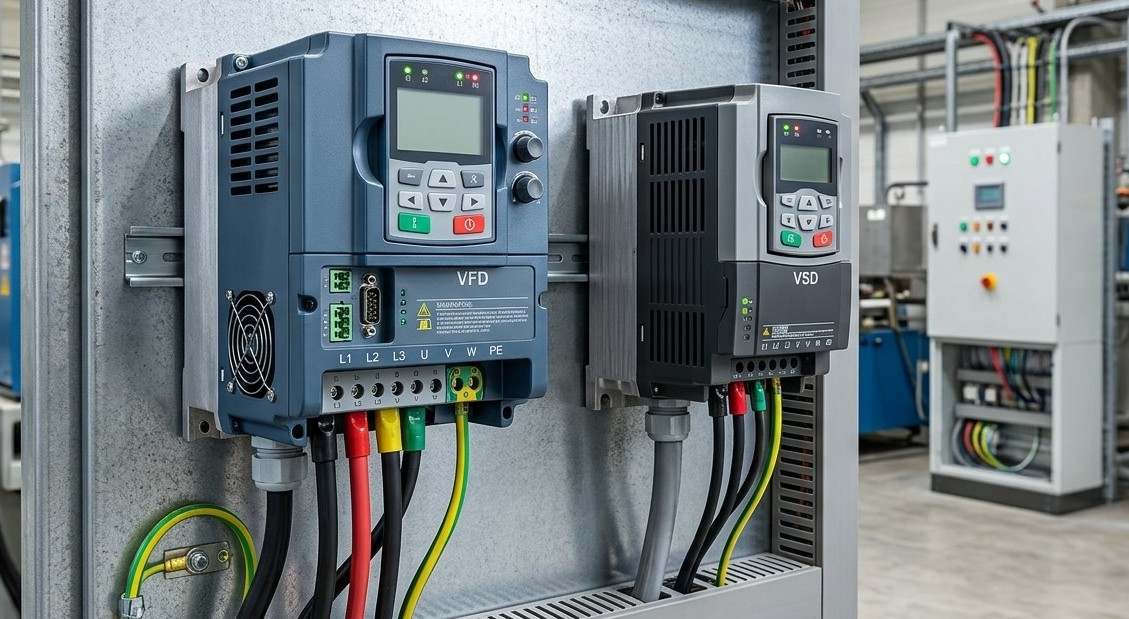
A variable-frequency drive (VFD) is an electronic controller that adjusts an electric motor’s speed and torque by changing the frequency and voltage of the power supplied to it. VSDs are the broader category: any device that varies the speed of a driven machine. Every VFD is a VSD, but not every VSD is a VFD.
The confusion comes from regional usage. Some manufacturers and contractors say “VSD” while others say “VFD.” IEC 61800 uses the formal term adjustable speed electrical power drive system.
When you write a specification, name the technology, not just the acronym. The VFD vs VSD question is really a question about mechanism.
How Does a VFD Control Motor Speed?
A VFD converts incoming AC power to DC, then rebuilds a variable-frequency AC output using an inverter. Because synchronous speed equals 120 times frequency divided by the number of poles, changing frequency directly changes motor speed. The drive adjusts voltage in proportion to keep flux and torque stable.
A VFD has three core stages:
- Rectifier: converts incoming AC to pulsating DC.
- DC bus: capacitors smooth the voltage and store energy.
- Inverter: IGBTs switch rapidly to synthesize variable-frequency output through pulse width modulation.
Control Modes
Scalar V/Hz control suits fans and pumps. Sensorless vector control delivers strong low-speed torque for conveyors and mixers. Closed-loop vector control with an encoder suits cranes, hoists, and precision positioning.
The energy case is strong for centrifugal loads. Under the affinity laws, a 20% speed reduction on a fan cuts power draw by roughly 49%.
What Other Types of VSDs Exist?
Beyond VFDs, VSDs include DC drives, mechanical variable-speed drives, hydraulic couplings, and eddy current clutches. Each changes speed by a different mechanism, from armature voltage control to fluid slip. Most modern industrial sites favor VFDs because they offer higher efficiency, finer control, and lower maintenance.
- DC drives: control armature voltage on DC motors. Torque is excellent, but brushes and commutators need regular upkeep.
- Mechanical VSDs: use belts and adjustable sheaves. They are simple, but wear quickly and offer a limited range.
- Hydraulic and fluid couplings: vary output speed through controlled slip.
- Eddy current clutches: transmit torque through a magnetic field, with similar slip losses.
Slip-based drives convert lost speed into heat. That is why VFD vs VSD comparisons in energy projects almost always favor the VFD.
VFD vs VSD: Which Should You Choose?
Choose a VFD when you run AC induction motors and need efficient, precise speed control across a wide range. Choose another VSD type when the application involves legacy DC motors, extreme torque at standstill, or environments where power electronics are impractical. Most new installations fall into the first category.
Drive Selection Matrix
| Criterion | VFD | DC Drive | Mechanical or Hydraulic VSD |
| Efficiency across range | High | High | Low to moderate |
| Speed range | Wide | Wide | Narrow to moderate |
| Low-speed torque | Strong with vector control | Excellent | Moderate |
| Maintenance | Low | Brush and commutator upkeep | Wear parts and fluid care |
| Harmonics | Needs mitigation | Needs mitigation | None |
| Retrofit cost | Moderate | High | Low to moderate |
Need a second opinion on drive selection? Request a motor and load assessment checklist to validate your specification before purchase.
Five-Point Pre-Specification Check
- Load profile: variable torque (fans, pumps) or constant torque (conveyors, compressors).
- Motor type: confirm inverter-duty insulation and bearing condition.
- Duty cycle: define minimum speed, ramp times, and braking needs.
- Power quality: verify limits against IEEE 519.
- Environment: check ambient temperature, dust, moisture, and enclosure rating.
What Are the Risks of Using a VFD?
VFDs introduce harmonic distortion, motor insulation stress, and bearing currents when applied without mitigation. These risks are manageable with line reactors, output filters, shielded cable, and shaft grounding rings, all selected during design rather than after a failure.
Watch for these failure vectors:
- Harmonics: non-linear input current can distort the supply and affect other equipment.
- Reflected waves: long cable runs, often beyond 30 meters, raise voltage spikes at the motor terminals. NEMA MG1 Part 31 defines insulation requirements for inverter-fed motors.
- Bearing currents: high-frequency common-mode voltage can pit bearings and shorten motor life.
- Low-speed heating: fan-cooled motors lose cooling airflow at reduced speed and may need auxiliary ventilation.
Maintenance also deserves planning. DC bus capacitors age with heat and often need replacement within 7 to 10 years, depending on ambient temperature.
Final Thoughts on VFD vs VSD
The VFD vs VSD decision comes down to mechanism, motor type, and load. A VFD is the dominant choice for AC motors because it delivers efficiency and control. Other VSDs still earn their place in legacy and specialized applications.
Treat the drive as part of a system. Motor insulation, cable length, power quality, and cooling all determine whether the installation performs reliably over its life.
Get the Right Drive for Your Motor Load
Need Variable Speed Drives that arrive ready for your plant or panel build? Aswan Electric, a supplier in UAE, can help you select suitable VFDs and VSDs based on your motor type, load profile, and site conditions.
Request a Drive QuoteFrequently Asked Questions
Is a VFD the same as a VSD?
No. A VSD is any device that varies machine speed, including mechanical, hydraulic, and DC systems. A VFD is a specific electronic VSD that controls AC motor speed by changing output frequency and voltage.
Can a VFD save energy on any motor application?
No. Savings are largest on variable-torque loads such as centrifugal fans and pumps, where power falls with the cube of speed. Constant-torque loads see smaller gains, though better process control can still reduce waste.
Can a VFD run any AC motor?
Most standard induction motors work with a VFD, but older motors may have insulation that cannot withstand fast voltage switching. Inverter-duty motors, output filters, and proper cabling reduce the risk of premature failure.
Related Electrical Guides
- The Ultimate Introductory Guide to Electrical Wires and Cables: Covers common wire and cable types and their applications.
- Cable Glands: Types, Sizes and Installation Guide: Explains cable gland types, sizing, and installation methods.
- Metal Enclosures: Materials, Properties and Selection Guide: Explores enclosure materials, properties, and selection factors.
- What Is a Variable Frequency Drive? Complete Guide: learn how a VFD controls motor speed and torque, and where it fits in your plant.
- What Is a Heavy Duty Connector (HDC)? A Complete Guide: everything you need to know before you specify one.