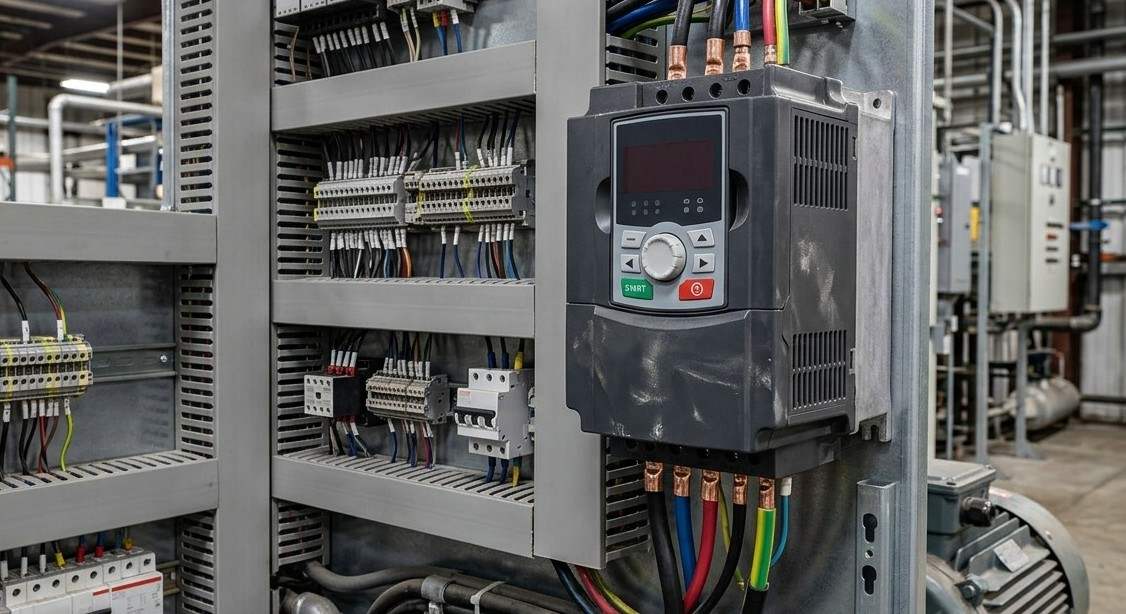
To choose the right VFD, match the drive’s output current to the motor’s full-load amps. Confirm the overload rating for your load type (about 110% for fans and pumps, 150% for conveyors). Then check supply voltage, ambient temperature, harmonic limits, and control protocols before purchase.
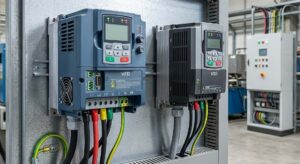
A variable frequency drive is an electronic motor controller that adjusts the speed and torque of an alternating current (AC) motor by changing the frequency and voltage of the power supplied to it. A poorly matched unit causes nuisance trips, motor overheating, and harmonic distortion across your plant.
Variable Speed Drives and Soft Starters are intelligent control devices that ensure efficient operation of electric motors. Only drives are used to adjust a motor’s speed continuously. This guide gives you a five-point selection matrix so you can specify the right drive the first time.
How Do You Size a Variable Frequency Drive Correctly?
A variable frequency drive must first match the motor’s full-load amps, supply voltage, and the load’s torque profile. Size on current, not horsepower, because motor efficiency, power factor, and winding design all change the amps a motor actually draws under load.
Start with the motor nameplate. Record full-load amps, voltage, frequency, and service factor. Then confirm the supply: voltage tolerance, phase, and available fault current. Specialists in variable frequency drive supply and installation verify these before quoting any unit.
Add margin only where justified. A drive rated 10-15% above motor current covers hot ambients or cyclic loads. Blanket oversizing wastes capital and can reduce low-speed control accuracy.
How Does Load Type Change the Drive You Need?
Load type sets the overload rating the drive must deliver. Variable-torque loads such as fans and centrifugal pumps need about 110% for 60 seconds, while constant-torque loads such as conveyors and crushers need 150% or more. Undersizing here causes the most common field failure: overcurrent trips at startup.
- Variable torque (fans, centrifugal pumps): torque falls with speed squared, so energy savings are greatest.
- Constant torque (conveyors, extruders, positive-displacement pumps): full torque at every speed. Check motor cooling at low speed.
- High inertia (crushers, centrifuges): often needs a heavy-duty rating and braking resistors.
Before requesting quotes, use a specification checklist to capture motor, load, and site data in one place.
Which Environmental and Power Quality Factors Matter?
Enclosure rating, ambient temperature, and harmonic distortion decide whether a drive survives and stays compliant. Derate most drives above 40°C or 1,000 metres altitude, and specify an IP or NEMA enclosure matching dust, moisture, and washdown exposure. Check harmonic limits before installation, not after complaints.
Common mitigation options:
- Line reactors or DC-link chokes to reduce harmonics
- EMC filters and shielded motor cable to limit interference
- Output dv/dt or sine filters on long cable runs to protect motor insulation
- Forced ventilation or a climate-controlled cabinet at hot sites
Harmonic limits are defined in IEEE 519, and drive performance and safety requirements fall under IEC 61800. For multi-drive installations, motor control panel manufacturing keeps filtering, cooling, and protection in one engineered enclosure. Persistent distortion may call for industrial power quality solutions.
Which Features Should You Prioritize?
Prioritize control mode, communications, built-in safety functions, and serviceability over headline features your application will never use. Sensorless vector control suits most standard pumps, fans, and conveyors, while closed-loop vector control suits precise positioning and tight speed and torque regulation. Match protocol support to your existing control system, and compare options in our Schneider variable frequency drive range.
Also decide whether you need a drive at all. If the goal is only to limit inrush current at start and stop, one of the Soft Starters may be enough. If the process needs variable speed, specify a drive.
Use this five-point matrix to score any candidate drive:
| Criterion | Question to answer | Red flag |
| Motor | Do amps and voltage match the nameplate? | Sizing by horsepower only |
| Load | Variable or constant torque? Overload needed? | No duty-cycle data |
| Environment | Temperature, altitude, enclosure rating? | No derating applied |
| Power quality | Harmonic limits and cable length covered? | No filter plan |
| Control and service | Protocol, safety, spares, local support? | Proprietary lock-in |
Review the maintenance side too. Confirm fan and capacitor replacement intervals, firmware update policy, and parameter backup procedures.
Next Steps
Choosing a variable frequency drive comes down to five checks: motor, load, environment, power quality, and control. Document each one, then verify performance with a commissioning test under real load.
Get the right variable frequency drive for your project
Want a second opinion on your specification? Aswan Electric’s engineers can review your motor data and site conditions and recommend a drive.
Book a Technical ConsultationFAQ
1- Should I size a VFD by horsepower or amps?
Size by amps. Motor current varies with efficiency and design, and the drive’s output current rating must exceed the motor’s full-load amps.
2- How much energy can a VFD save?
On variable-torque loads such as fans and pumps, reducing speed by 20% can cut power consumption by roughly 50%, because power falls with the cube of speed.
3- Can any motor run on a VFD?
Most standard induction motors can, but older motors may lack inverter-duty insulation. Long cable runs and low-speed operation may require filters or auxiliary cooling.
Related Electrical Guides
- The Ultimate Introductory Guide to Electrical Wires and Cables: Covers common wire and cable types and their applications.
- Cable Glands: Types, Sizes and Installation Guide: Explains cable gland types, sizing, and installation methods.
- Metal Enclosures: Materials, Properties and Selection Guide: Explores enclosure materials, properties, and selection factors.
- What Is a Variable Frequency Drive? Complete Guide: learn how a VFD controls motor speed and torque, and where it fits in your plant.
- What Is a Heavy Duty Connector (HDC)? A Complete Guide: everything you need to know before you specify one.